
USB flash drives are still widely used in the workplace due to their affordability and portability. However, the USB drive sitting in your desk drawer or pocket could be a major liability.
Many companies invest heavily in cybersecurity, but ignore the potential dangers posed by flash drives. Yet, unsecured USB drives and poor usage can lead to millions of dollars in fines. These jaw-dropping amounts stem from regulatory frameworks that enforce strict privacy and security standards.
Thankfully, there is one solution that ensures compliance with all regulations related to sensitive data.
What To Know:
- The General Data Protection Regulation (GDPR) is a set of laws passed by the European Union (EU). It governs the collection, storage, and processing of personal data.
- The Health Insurance Portability and Accountability Act (HIPAA) is a landmark law that protects Americans’ medical histories. HIPAA forbids the unauthorized disclosure of health records without patient consent.
- The Cybersecurity Maturity Model Certification (CMMC) is a Department of Defense mandate to safeguard federal contracts and controlled information.
- Encrypted flash drives meet the shared criteria for GDPR, HIPAA, and CMMC compliance.
Real Cost of Non-Compliant Flash Drives
Each year, IBM releases a report that details the cost of a data breach. In 2025, the global average was $4.44 million. At the same time, the average cost of a data breach in the United States reached a record-breaking $10.22 million.
Regulatory fines were one of the biggest reasons for those large sums. According to IBM, nearly a third of entities affected by a data breach had to pay a hefty fine. In fact, almost half of the fines imposed exceeded $100,000.
In addition, these fines are levied by different authorities. As a result, a single violation could draw fines from multiple regulators. The prospect of stacking penalties underscores the need for a unified posture rather than a web of separate policies.
Simply loading the wrong data onto a thumb drive or losing the device could be a very costly mistake.
GDPR Compliance Strategies
GDPR compliance applies to any company that handles the personal data of EU citizens. For example, a financial services firm based in the United States is still obligated to comply with GDPR rules. Therefore, it is crucial to develop compliant strategies for collecting, storing, and processing data in line with EU law.
What Is GDPR Compliance?
Article 32 of the GDPR outlines the controls that data collectors and processors must implement to ensure compliance.
The article requires companies to provide appropriate security measures to address the risks posed to a subject’s personal data. They must maintain state-of-the-art, resilient systems to protect personally identifiable information (PII). They also need to clearly define the nature, scope, context, and purpose of stored data. Regular testing, response time to incidents, and potential impacts on rights and freedoms are other core benchmarks.
Owning a standard flash drive containing personal data of EU citizens could constitute a breach of Article 32.
GDPR Compliance Checklist for Data Storage
In practice, GDPR compliance comes down to one principle. The party that controls and processes sensitive data is solely responsible for securing it. Any unauthorized access, alteration, or disclosure of personal data is a breach of privacy. A single violation of GDPR laws could result in severe penalties.
For this reason, the encryption and pseudonymization of personal data is essential.
Storing personal info on an encrypted USB drive completely changes the risk profile of external storage. Even in the event of device loss or theft, the private data remains protected by robust encryption. The extra layer means that bad actors must decipher an encryption key to obtain valuable data.
Here is a quick GDPR compliance checklist for entities that store the personal data of EU citizens:
- Encrypt data at rest on removable media.
- Minimize the amount of personal data on portable devices.
- Retain only relevant data for short periods of time.
- Use remote wipe capabilities if available.
- Document all aspects of the data protection program.
In short, an encrypted USB flash drive satisfies the bulk of GDPR’s rigid requirements at an affordable price.
HIPAA Compliance Solutions

Healthcare settings present unique challenges when handling data. Providers often need fast, flexible access to electronic medical records (EMR) and protected health information (PHI). However, the sensitivity of patient data can mean massive penalties for HIPAA violations.
For example, the average cost of a healthcare data breach was $7.42 million in 2025. The figure is a 67% increase over the global average for all breaches.
Sizable fines for mishandling patient data make HIPAA compliance imperative.
What Is HIPAA Compliance?
Signed in the U.S. in 1996, HIPAA established national standards for securing electronic protected health information (ePHI). The law was introduced in five phases as the government finalized all of its rules. It took full effect in 2013. Since then, anyone who creates, stores, receives, or transmits patient data must comply with HIPAA.
The HIPAA Security Rule is one of the most consequential provisions for covered entities and business associates. The rule lists the technical safeguards that regulated entities must implement to comply with HIPAA. It provides encryption requirements based on NIST standards and guidelines.
In the past, the Security Rule was somewhat flexible, as long as entities could prove they had reduced exposure risks. However, HIPAA updates and changes in 2026 are revising rules around these addressable specifications. The change accounts for the rise in ransomware against healthcare institutions.
Non-compliance carries high costs. Penalties can total millions of dollars per violation category. Fines are especially punitive when an entity fails to address a known security gap.
HIPAA Compliance Checklist for Data Storage
The strict nature of the Security Rule makes a HIPAA compliance checklist necessary.
The best HIPAA compliance practices as they relate to a storage device include:
- Encrypt all USB drives containing ePHI with AES-256.
- Ban all unencrypted flash drives from the site.
- Enable automatic wipes after failed attempts.
- Train staff on policies for removable media.
The right USB flash drive can meet HIPAA’s Security Rule out of the box and ease compliance headaches.
CMMC Compliance Requirements
CMMC compliance became a requirement for contractors that work with the U.S. Department of Defense (DoD) in late 2025. Any member of the Defense Industrial Base (DIB) that stores, processes, or transmits sensitive data must follow the CMMC framework.
What Is CMMC Compliance?
CMMC compliance comes down to conforming to hundreds of cybersecurity controls. The controls are split across three levels, depending on the sensitivity of the program.
Level 2 is the most relevant threshold for most members. In that regard, compliance is heavily tied to NIST SP 800-171. The NIST standard applies to any party storing, processing, or transmitting Controlled Unclassified Information (CUI) and Federal Contract Information (FCI). It mandates that all contractors use FIPS-validated cryptographic modules for data at rest, in transit, and in use.
Failure to remain compliant with the CMMC could result in loss of certification, termination of federal contracts, and financial penalties. Being unable to supply the government or military could lead to a loss of revenue.
CMMC Compliance Checklist for Data Storage
The Media Protection (MP) domain within Level 2 of the CMMC framework governs how contractors can use USB drives. The domain dictates usage policies, transport protocols, encryption standards, and data destruction methods.
The following criteria are essential for CMMC compliance:
- Encrypt all USB drives storing CUI.
- Authorize only encrypted flash drives.
- Label removable media containing CUI.
- Restrict use of USB drives on external systems and conduct audits.
- Sanitize flash drives before disposing of them.
An encrypted USB flash drive with FIPS 140-2 Level 3 validation is purpose-built for CMMC compliance.
Encrypted Flash Drives Comply With GDPR, HIPAA, and CMMC
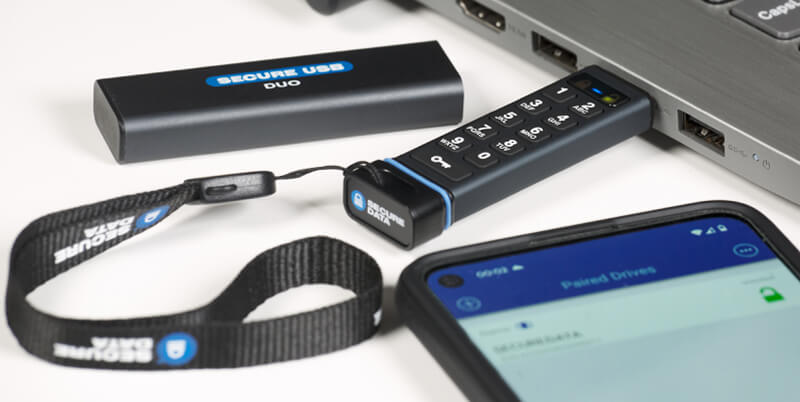
Despite the differences in these regulations, a single solution exists that satisfies all of their compliance requirements.
Using an encrypted flash drive is one of the easiest and most effective steps toward GDPR, HIPAA, and CMMC compliance.
Hardware Encryption
Hardware encryption versus software encryption is widely discussed. However, only hardware encryption offers constant protection. A hardware-encrypted flash drive never exposes keys to the host system.
FIPS 140-2 Level 3 Validation
FIPS 140-2 Level 3 Validation is the gold standard for cryptographic modules. The certification signifies that the USB drive has added resistance to physical attacks.
XTS-AES-256 Encryption
The most powerful computers in the world cannot crack XTS-AES-256. It encrypts each sector of the flash drive to conceal data patterns.
Epoxy-Coated Components
Encrypted thumb drives seal critical components to prevent the extraction of encryption keys. The tamper-resistant design protects sensitive data even if a malicious actor steals the device.
Auto-Wipe Feature
Auto-wipe erases all stored data after a set number of failed login attempts and destroys the encryption key. It is a strong deterrent against brute-force attacks.
Remote Management
Remote management allows IT teams to enforce policies and oversee all media from a central console.
Your Quick Compliance Checklist
Take this simple test for compliance with regulatory frameworks:
- Does sensitive data leave your facilities on an unencrypted USB flash drive?
- Do you have a dedicated removable media strategy?
- Can your IT team remotely erase a missing USB flash drive?
- Have you documented your encryption standards for auditors?
- Are your USB flash drives FIP 140-2 validated?
If you answered no to these questions, then your USB sticks are a liability.
SecureUSB® Drives for Business, Healthcare, and Government
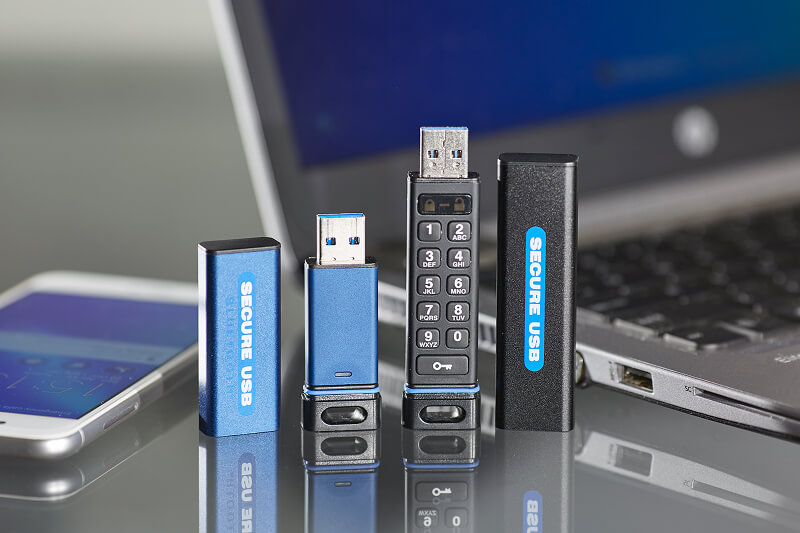
SecureData is a leading provider of data protection solutions and secure storage options. Our SecureUSB® products use tamper-resistant components, employ XTS-AES-256 encryption, hold FIPS 140-2 Level 3 validation, and include auto-wipe mechanisms. They are ideal for businesses of all sizes, healthcare institutions, medical vendors, government agencies, and defense contractors.
The SecureUSB® BT blends military-grade encryption, biometric authentication, and remote-wipe capabilities. The SecureUSB® KP has a built-in keypad that locks data behind a passcode. The SecureUSB® DUO combines the best features of both flash drives.
Contact us to request a free evaluation and see how our encrypted flash drives perform inside your environment.
Frequently Asked Questions
Does GDPR require encrypted USB drives?
GDPR does not require data controllers or processors to use encrypted USB drives. However, Article 32 mandates that parties with personal data must implement “appropriate technical measures” to protect EU citizens. Hardware encryption is the most common, proactive measure for GDPR compliance regarding data storage. An encrypted flash drive with AES-256 reduces the risk of a reportable incident if the device is lost or stolen.
Does HIPAA require encrypted USB drives?
HIPAA does not prohibit the use of unencrypted USB drives by healthcare providers and business associates. However, the HIPAA Security Rule requires all regulated entities to protect patient data at rest. Unencrypted media is one of the highest risks for a data breach. You will face severe penalties if portable media containing protected health information goes missing. As a result, an encrypted flash drive with FIPS 140-2 Level 3 validation and XTS-AES-256 encryption remains the industry standard.
What encryption standard does CMMC require?
The CMMC aligns with NIST SP 800-171. Therefore, contractors must use encrypted external storage with FIPS 140-2 Level 3 validation and XTS-AES-256 encryption. These are the only devices that meet the CMMC’s strict media protection requirements.








.png)
